
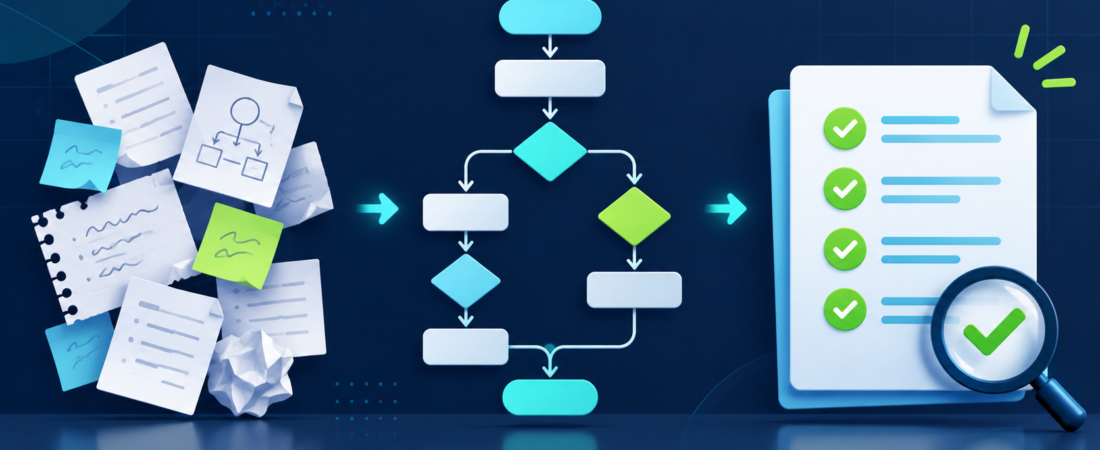
A ChatGPT SOP can help turn rough process notes into a usable first draft, but the source material rarely arrives in a clean order. One person remembers the happy path. Another adds an exception in a chat message. A screenshot shows a button that has since moved. The result may be understandable to the person who does the work every day, but it is not yet a dependable standard operating procedure.
ChatGPT can help organize that material into a first draft. The important boundary is that the model should structure evidence you provide, not invent missing steps. OpenAI’s prompting guidance recommends clear, specific instructions and iterative refinement. This workflow applies those ideas to SOP writing, then adds an owner review and a test run.
This is a practical drafting method, not a guarantee that an AI-generated procedure is correct. The person who owns the process must confirm the steps, permissions, safety requirements, and exceptions before anyone relies on it.
Define what the SOP must accomplish
Start with the outcome, boundary, and intended reader. “Document customer onboarding” is too broad. “Create a checklist for opening a new client workspace after a contract is signed” gives the procedure a recognizable start and finish.
Write down five facts before you ask ChatGPT to draft anything:
- Trigger: the event that starts the procedure.
- Finished state: what must be true when the procedure is complete.
- Operator: the role expected to perform the work.
- Required access: systems, files, approvals, or permissions the operator needs.
- Escalation owner: the role that decides what to do when the documented path does not fit.
Keep names generic unless a named person genuinely owns the responsibility. Roles survive staffing changes better than personal names. Do not invent an owner or approval rule because it would make the document look complete.
Collect evidence without cleaning it first
Gather the notes, screenshots, existing checklists, form fields, and examples that describe the current process. Keep a source label on each item, such as “interview notes, 2026-09-24” or “billing checklist version 3.” If two sources disagree, preserve both statements. A conflict is a review item, not an invitation for the model to choose the more plausible answer.
Check your organization’s data-sharing rules before placing internal material in ChatGPT. Remove passwords, access tokens, customer information, and details that the procedure does not need. OpenAI documents account-level data controls, but your workplace policies still determine what you may share and which workspace you may use.
Ask for an inventory before a draft:
You are organizing source material for an SOP. Do not write the procedure yet.

The SOP should cover: [outcome and boundary]
The intended operator is: [role]

Inventory the supplied notes. List every stated action, required input, system, decision, exception, approval, and finished-state check. For each item, cite its source label. Put contradictions, missing details, and ambiguous terms in a separate questions list. Do not infer an answer that is not present in the sources.
Compare the inventory with the raw material. Confirm that unusual conditions and small verification steps were not dropped. If a source says “check the account,” replace that vague phrase only after the process owner explains what to check and what counts as acceptable.
Build the skeleton around decisions
A useful SOP is more than a numbered list. It tells the operator when to stop, when to branch, and how to know that the work succeeded. Ask ChatGPT to propose a skeleton with these sections:
- Purpose and scope
- Prerequisites and access
- Inputs
- Procedure
- Decision points and exceptions
- Verification
- Escalation and ownership
- Revision record
Using only the source inventory, create an SOP outline. Keep the procedure in chronological order. Give every decision point an explicit condition and destination, such as "If the account is already active, go to Step 7." Add placeholders marked [OWNER INPUT NEEDED] where a required fact is missing. Do not fill placeholders with assumptions.
Review the outline before expanding it. Check that the first step begins at the documented trigger and that the last step proves the finished state. Move background explanation out of the action sequence. An operator should not have to read a paragraph of history to find the next action.
Draft steps that can be observed
Each step should contain an action and, when needed, a visible result. “Process the request” is not testable. “Open the request, confirm the signed agreement is attached, and set the status to Ready for Setup” can be observed and checked.
Use interface labels only when they are confirmed in the current system. If the notes refer to an old button or an uncertain menu, leave a verification flag. Avoid directions based only on color or screen position because interfaces and accessibility settings vary.
Expand the approved outline into a draft SOP.

For every numbered step:
1. Start with a direct action verb.
2. Name the input or screen used when the source provides it.
3. State the expected result when it matters.
4. Preserve the source label in a review note.
5. Mark unsupported details [VERIFY] instead of guessing.

Keep exceptions next to the step that triggers them. Do not invent menu names, owners, deadlines, permissions, or system behavior.
Remove source labels from the reader-facing copy only after review. Keep them in a change log or working version so a reviewer can trace a disputed step back to the evidence.
Separate the happy path from exceptions
Many weak procedures work only when everything is normal. Ask the process owner what commonly blocks completion: missing approval, duplicate records, unavailable systems, unusual account types, or failed validation. Add only confirmed branches.
For each exception, document four things: the condition, the safe immediate action, the escalation role, and the evidence to preserve. If the correct action is unknown, the procedure should say to stop and escalate. A polished guess is worse than a visible gap.
Run a contradiction and assumption review
Before testing the SOP, ask ChatGPT to challenge the draft. This is not a factual approval. It is a way to surface phrases that still need human attention.
Audit this SOP against the source inventory.

Create four lists:
- steps with direct source support
- steps that combine information from multiple sources
- unsupported assumptions or invented details
- contradictions and unresolved questions

Also flag vague verbs, undefined acronyms, missing permissions, unverified interface labels, and branches with no destination. Quote the relevant step number for every finding. Do not rewrite the SOP yet.
The NIST Generative AI Profile recommends human review processes that account for the context of use and limitations automated systems can miss. For an SOP, that means the process owner should examine every flagged assumption and confirm the procedure against the real environment.
Test the SOP with a dry run
Give the draft to someone who understands the work but did not write the notes. Use a safe sample or test environment where possible. Ask the tester to follow the document literally and record where they pause, make an assumption, or need information that is not present.
Use a small test log with the step number, expected result, actual result, evidence, and proposed correction. Do not silently edit the SOP during the run. A separate log makes it easier to distinguish a documentation problem from a system problem.
Turn the test notes below into a revision plan. For each issue, identify the affected SOP step, classify it as missing instruction, incorrect instruction, unclear wording, interface change, access problem, or exception not covered, and propose the smallest correction.

Do not mark an issue resolved until the process owner confirms the correction and the affected step passes a retest.

Test notes:
[paste notes]
Retest changed branches, not just the happy path. If Step 4 changed, check any later step that depends on its result. For a high-impact procedure, use the review and approval process required by your organization.
Publish a controlled version
After the owner approves the content, add a version number, effective date, owner role, approval role, and next review date if your organization uses one. Link to controlled templates instead of pasting disposable copies into the SOP. Store the approved version where operators know to find it.
Keep the rough notes, inventory, questions, test log, and approval record with the working materials. They explain why a step exists and make later revisions easier. When the system changes, update the SOP through the same review and test process rather than asking ChatGPT to “refresh” it from memory.
- The trigger and finished state are explicit.
- Every action is supported or marked for verification.
- Decision branches have destinations.
- Permissions and escalation roles are confirmed.
- A second person completed a dry run.
- Corrections were retested and approved.
The useful role for ChatGPT is structure, not authority. It can help turn scattered evidence into an organized draft and a focused review list. The people responsible for the process decide whether the procedure matches reality and is safe to use.
Want more practical AI workflows with built-in checks? Join ZippByte Weekly for concise prompts and verification habits you can adapt to your own work.