Reading your notes twice is not the same task as answering a question without them. A practice quiz gives you a different way to inspect what you can recall, explain, and apply. ChatGPT can draft the questions, but a plausible answer key can still contain a wrong rule, an invented exception, or a misleading explanation.
This workflow turns a small, approved set of notes into two separate artifacts: a question sheet and a source-linked answer key. You verify the key before using the questions, then record what you missed. It is useful for personal study or low-stakes training review, not for certifying competence or making decisions about other people.
Choose one learning goal and a bounded source
Start with something observable, such as explaining a process, distinguishing two concepts, or applying one documented rule. A request to test everything in a whole course encourages an uneven quiz. Pick one section and a short first batch of questions.
Use material you are permitted to share. Remove personal details, customer information, confidential examples, credentials, and restricted assessment content. You can paste a short approved excerpt rather than upload an entire document. Keep your original notes unchanged, and record the version used for this quiz.
If the notes contain a contradiction, missing step, or outdated policy, resolve that first. A source-linked question can faithfully reproduce an error in the source. The learning goal and source selection still need your judgment.
Give each source passage a stable label
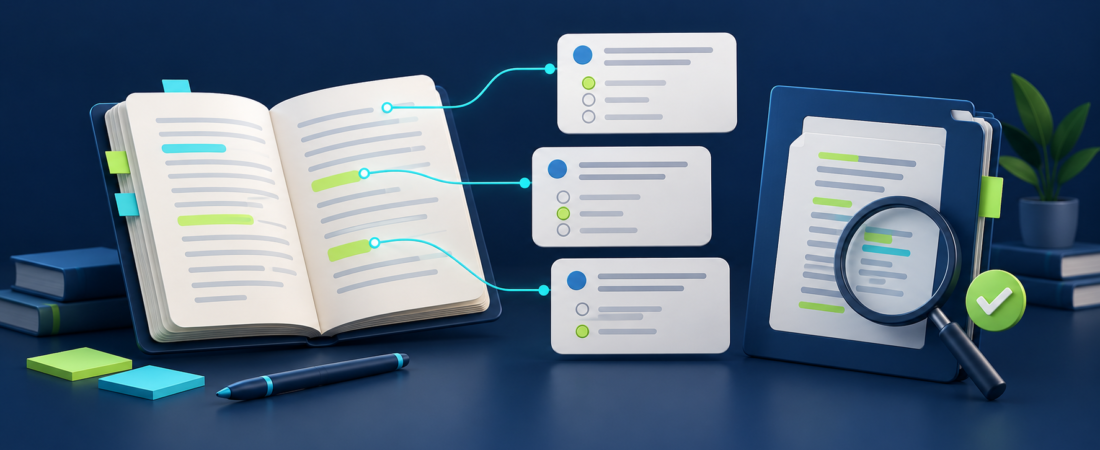
Label paragraphs S1, S2, and S3, or use actual section and page references. Preserve those labels when copying text into the conversation. Ask for a source map before any questions so you can catch skipped concepts or topics that the notes do not support.
Help me prepare a small practice quiz from the material below.
Audience: [learner and prior knowledge]
Learning goal: [one observable goal]

Use only the supplied passages, identified by their source labels.
First return a coverage plan: concept, source label, and proposed question type.
Flag contradictions, missing definitions, and goals unsupported by the source.
Do not write the questions yet. Do not add outside facts.

Sources:
[paste labeled, approved passages]
Review the map against the notes yourself. A definition question and an application question can cover the same concept usefully; five near-identical definition questions usually do not. Decide where repetition serves practice and where it only inflates the quiz.
Draft questions without leaking the answers
For the first batch, use short-answer questions. They make it easier to inspect whether the wording is clear and whether the required answer exists in the source. Add a simple application question when the material contains an explicit rule. Do not invent missing scenario conditions.
Using the approved coverage plan, draft five short-answer practice questions.
Assign stable question IDs Q1 through Q5.
Use direct, unambiguous wording and one main task per question.
Include recall, explanation, and application only where the source supports them.
Return the question sheet only, without answers or supporting passages.
Do not disclose the answer in a hint or leading phrase.
Flag any question you cannot support instead of filling the gap.
If you later use multiple choice, check that exactly one option is best under the stated conditions. Wrong options must be clearly identified in the reviewed key. Do not reuse a false option as an unqualified explanation or let option length reveal the answer.
Build and verify the answer key separately
Request a separate key with the expected answer, acceptable variations, required elements, and an exact source location. A source label alone is not enough: open the passage and confirm that it supports the entire answer, including qualifiers and exceptions.
Create a separate draft answer key for these question IDs.
For each include:
- expected answer
- required elements and acceptable wording variations
- source label and the specific supporting sentence or section
- assumptions or unresolved ambiguity

Use only the supplied source material.
If the source cannot support a complete answer, mark the item unsupported.
Do not add a rule, exception, deadline, or explanation from general knowledge.
Questions: [paste question sheet]
Sources: [paste the same labeled passages]
Review every key entry before taking the quiz. Edit or remove unsupported items. Check a second direction too: does each question actually ask for the answer shown in its key? A correct fact can still be the wrong answer to a poorly worded question.
Try a tiny worked example
Fictional training notes: These constructed rules demonstrate the method. They are not a real organization’s policy.
- S1: Make a working copy before editing a reference file.
- S2: Keep the original reference file unchanged during the exercise.
- S3: Mark any claim you cannot verify as Review required.
A reviewed question-and-key pair could look like this:
- Q1: Which file should you edit? Key: The working copy. Support: S1.
- Q2: May you update the original during the exercise? Key: No. It remains unchanged. Support: S2.
- Q3: What should happen to a claim you cannot verify? Key: Mark it Review required. Support: S3.
- Q4: How long must the working copy be retained? Key: Not specified. There is no supporting rule.
Q4 is a useful failure test for the generator, but it is not a fair retention-knowledge question. Remove it from the learner’s scored set or explicitly make recognizing missing information the learning goal. Do not let ChatGPT fill the gap with an invented retention period.
Audit ambiguity, coverage, and scoring
Check each question against the learning goal. Look for unsupported detail, two valid interpretations, duplicated tasks, and answers that require knowledge the learner was not given. A scenario should supply every condition needed to apply the rule.
Review this draft quiz and key as a skeptical editor.
For each question report: supported, ambiguous, duplicated, or unsupported.
Check whether the key answers the exact question and whether wording leaks the answer.
Identify missing conditions, unsupported explanations, and uncovered learning goals.
Suggest the smallest correction; do not add new content.
Your review is advisory. I will verify it against the passages.
Quiz and key: [paste]
Learning goal and sources: [paste]
Set the scoring rule before checking your responses. For a personal quiz, correct, partly correct, and needs review may be enough. In Q3, a response that calls the claim verified has confused the review flag with verification. Do not reward matching vocabulary when the meaning is wrong.
Use your mistakes to plan the next review
Answer from the question sheet with the notes and key closed. Compare your response with the reviewed key, then reopen the supporting passage. Record the question ID, what you missed, the source label, and the next action: reread, clarify, or practice applying the rule.
Keep uncertain scoring visible. ChatGPT can suggest feedback, but you should settle disputed answers against the source. Do not let a second confident AI explanation override the checked key.
The Institute of Education Sciences’ 2007 practice guide recommends quizzing to revisit key content and spacing learning over time. That supports the study principle, not the accuracy of AI-generated quizzes or a guarantee of your results. Revisit missed concepts later rather than treating one successful attempt as permanent mastery.
Keep the quiz reusable without making it authoritative
Save the source version, learning goal, question IDs, reviewed key, corrections, and review date together. If the source changes, compare it with the key before reuse. A changed exception can invalidate an otherwise well-written question.
- Every scored item has a clear goal and verified supporting passage.
- The question sheet contains no answer key or accidental hints.
- Unsupported and ambiguous questions were removed or corrected.
- Scoring rewards meaning, with acceptable variations recorded.
- Mistakes lead back to a source and a specific review action.
- The quiz is labeled personal practice, not an official assessment.
OpenAI’s prompting guide advises explicit scope, relevant context, sources, and uncertainty checks. The prompts here are ZippByte’s recommended adaptation, not a validated assessment instrument. Use official assessments and qualified human review wherever consequences require them.
For more practical AI prompts with verification built in, join ZippByte Weekly. Get workflows you can adapt and test before relying on the result.